
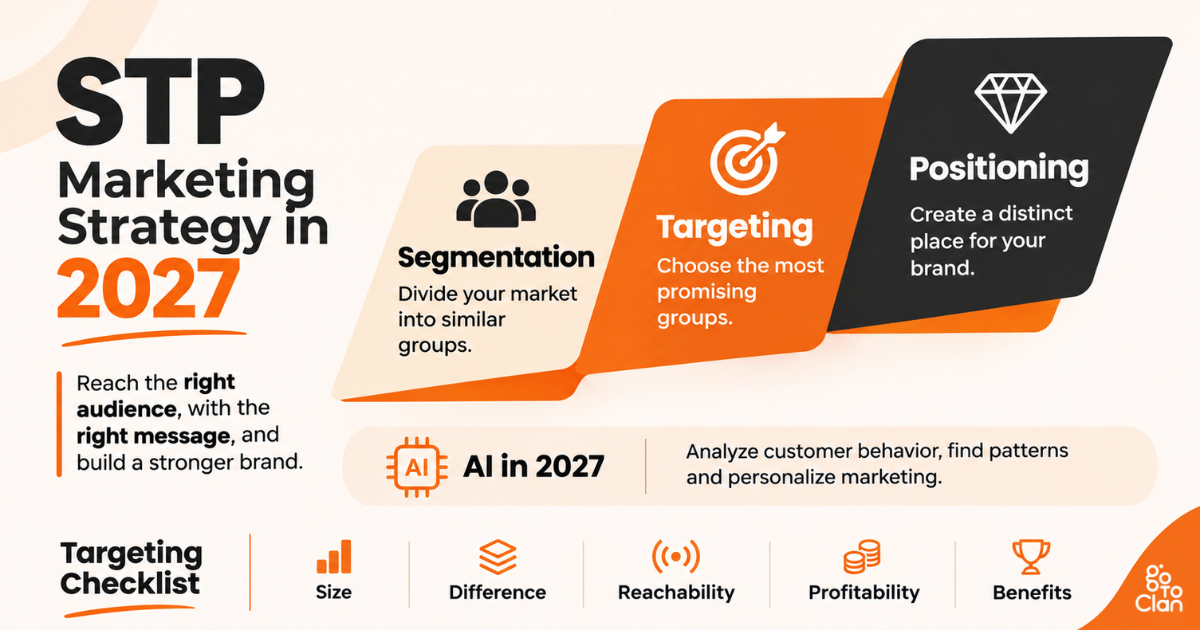
STP marketing isn’t a new concept. Brands have been using it for decades to understand their customers and sell their products to the right people. But marketing in 2027 looks quite different. With AI analyzing customer behavior, predicting buying decisions, and helping brands personalize their campaigns, the way businesses understand their audience is changing.
Here’s a simple example. Two people are 25 years old, live in the same city, and earn almost the same salary. But one happily spends $200 on skincare, while the other thinks $20 is too much. Same age, same location, similar income, but completely different buying habits!
And that’s exactly what makes STP in marketing so interesting. It’s not just about knowing who your customers are. It’s about understanding what they want, why they buy, and what makes them choose one brand over another. And with AI becoming a regular part of marketing, there’s a lot more to explore in 2027.
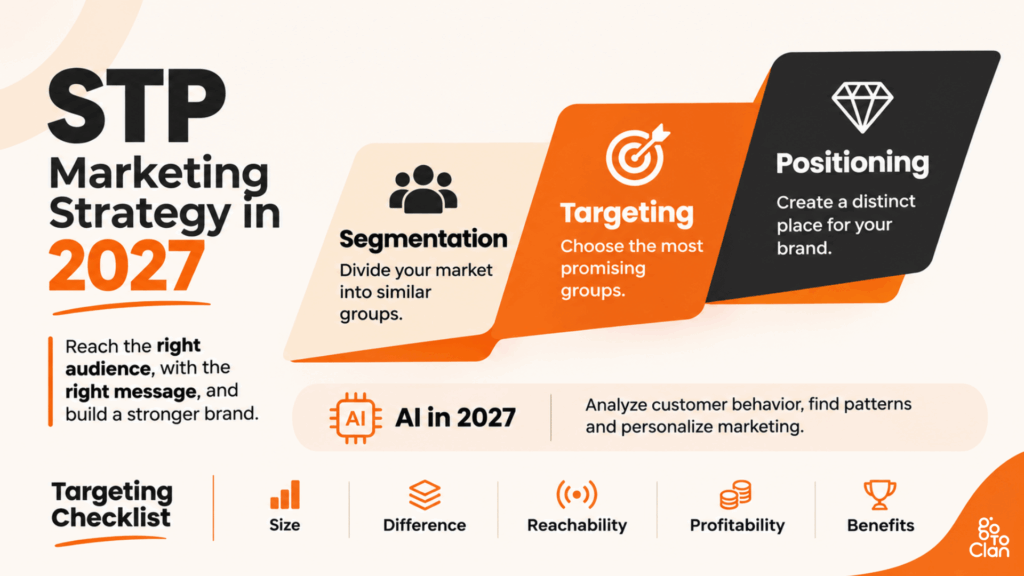
Table of Contents
What Is STP Marketing?
STP stands for Segmentation, Targeting, and Positioning. It’s a marketing model that helps businesses figure out who their customers are, which customers they should focus on, and how they want people to see their brand. Instead of trying to sell everything to everyone, brands can focus their time, money, and efforts on the right audience.
Let’s say you’re launching a skincare brand. You could divide your potential customers into groups based on age, skin type, budget, lifestyle, and buying habits. That’s segmentation. Next, you decide to focus on young adults with oily, acne-prone skin. That’s targeting. Finally, you position your brand as an affordable, science-backed skincare solution for young adults. That’s positioning.
The STP full form in marketing might sound simple, but there’s a lot happening behind these three steps. From studying customer behavior to analyzing competitors and creating a unique brand identity, each stage involves several decisions. And with AI making customer insights more accessible, businesses now have more ways to put this model into practice.
STP Marketing Strategy in 2027
Marketing has come a long way from grouping customers by age, gender, and location. In 2027, brands can use AI to study browsing habits, shopping preferences, customer feedback, and even predict what people might buy next. But having all this data doesn’t automatically mean you understand your customers. You still need a smart strategy to make sense of it. Let’s explore how segmentation, targeting, and positioning work in today’s AI-driven marketing world.
1. Segmentation
Imagine you’re selling running shoes. Some customers are professional athletes, some run every morning, and others just want comfortable shoes for everyday use. Would you market the same shoes to all three groups in the same way? Probably not!
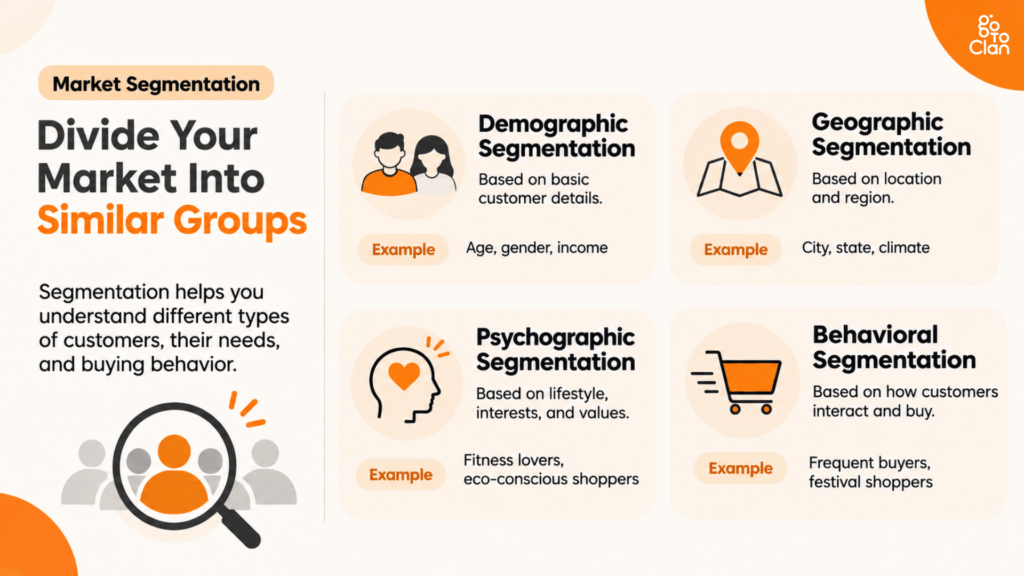
That’s what market segmentation is all about. You divide a large audience into smaller groups of people who share similar characteristics, needs, or buying habits. And in 2027, AI can help brands identify patterns that traditional customer surveys might miss.
Demographic Segmentation
Demographic segmentation groups people based on characteristics such as age, gender, income, education, occupation, and family status.
For example, a skincare brand might create different product lines for teenagers dealing with acne, working professionals concerned about early signs of aging, and older adults looking for mature skincare solutions.
In 2027, AI can help brands combine demographic information with customer preferences and purchasing patterns. After all, two 30-year-olds earning the same salary might have completely different skincare routines and budgets.
Geographic Segmentation
Geographic segmentation divides customers based on where they live. This could be their country, state, city, neighborhood, or even whether they live in an urban or rural area.
Think about a clothing brand. Customers in New York might be shopping for winter coats in December, while customers in Miami are still looking for lightweight outfits. The same brand needs different products and campaigns for these two markets.
With AI-powered location insights, weather data, and regional shopping trends, brands in 2027 can plan campaigns that better reflect local demand. They can even adjust product recommendations based on changing weather conditions or seasonal preferences.
Psychographic Segmentation
Psychographic segmentation looks beyond basic customer details. It focuses on people’s lifestyles, personalities, interests, values, attitudes, and motivations.
For example, two customers might have the same income, but one prefers affordable fashion while the other willingly pays more for sustainable clothing. Their buying decisions are influenced by what matters to them, not just how much money they earn.
In 2027, AI-powered customer research can help marketers spot these preferences through surveys, reviews, and customer conversations. However, brands still need to validate these insights rather than assume that every online interaction reveals someone’s personality or values.
Behavioral Segmentation
Behavioral segmentation groups customers based on what they actually do. This includes their purchase history, browsing habits, product usage, brand loyalty, and responses to marketing campaigns.
Ever noticed how an online shopping platform recommends products similar to something you recently viewed? That’s a familiar example of behavioral data being used for personalization.
In 2027, AI can help brands identify repeat buyers, predict when customers might need a refill, and recognize shoppers who are likely to stop purchasing. With customer consent and responsible data practices, businesses can make their marketing more relevant without bombarding everyone with the same advertisements.
2. Targeting
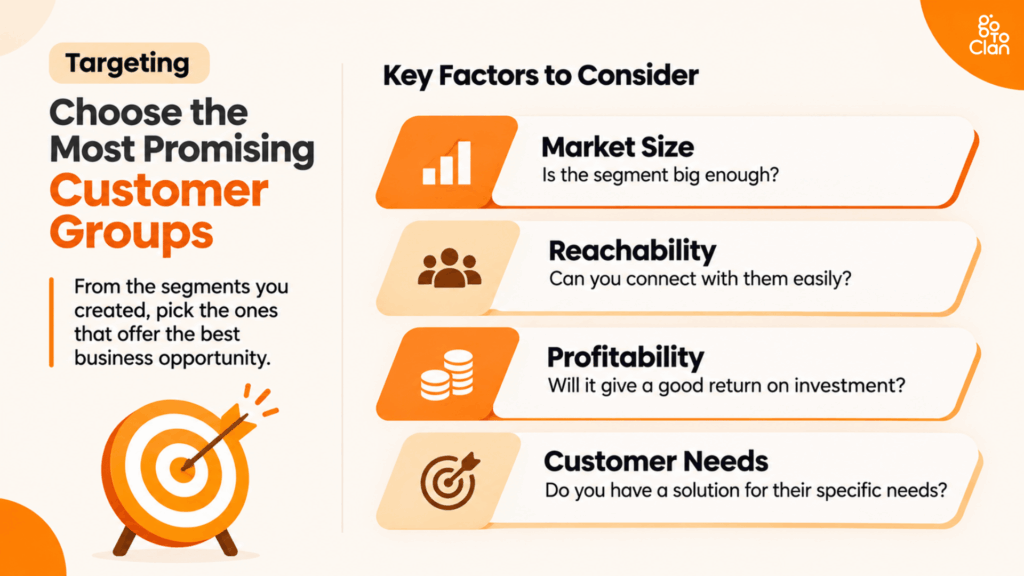
Now that you’ve divided your audience into different segments, should you start marketing to all of them? Of course not! Some groups might be interested in your products but can’t afford them. Others might have the budget but no real reason to buy. Targeting helps you figure out which customer segments are actually worth your time and marketing budget.
In 2027, AI can help brands compare audience segments, estimate conversion potential, and predict customer lifetime value. But before choosing your target audience, there are five important things to consider.
Size
Your target audience should be large enough to generate meaningful business. Imagine launching a premium dog food brand in a small town where only a handful of people own dogs. Even if everyone buys your product, you might struggle to make a profit.
AI-powered market research can help businesses estimate audience size, identify growing customer groups, and discover opportunities beyond their existing markets.
Difference
Not every customer segment needs a separate marketing campaign. If two groups have similar needs, buying habits, and responses to advertisements, treating them differently might just waste your budget.
For example, if customers aged 25-30 and 31-35 respond similarly to your skincare campaigns, you might not need separate strategies for them. In 2027, AI can help marketers compare customer behavior and identify whether these groups are genuinely different.
Reachability
Finding your ideal customers is one thing. Actually reaching them is another!
Let’s say you’re selling luxury furniture to wealthy homeowners. You know exactly who your customers are, but can you reach them through Instagram ads, Google Search, interior designers, or luxury magazines?
In 2027, AI-powered advertising platforms can help brands identify suitable channels and optimize campaigns. However, privacy regulations, platform restrictions, and customer consent still matter. A valuable audience isn’t useful if you can’t reach it legally and effectively.
Profitability
Imagine spending $100 on advertising to acquire a customer who purchases a $20 product. Unless that customer keeps buying from you, your marketing strategy probably needs some serious reconsideration!
Profitability is about understanding customer acquisition cost (CAC), profit margins, repeat purchases, and customer lifetime value (CLV). AI can help businesses forecast these numbers and identify customer groups with stronger revenue potential.
Remember, the biggest audience isn’t always the most profitable one. Sometimes, a smaller group of loyal customers can bring better returns.
Benefits
Here’s something interesting. Two customers can buy the exact same product for completely different reasons.
Take plant-based milk. One customer might choose it because they’re lactose intolerant, while another prefers it because they want to avoid animal products. Same product, different expectations!
Understanding these benefits helps brands create messages that actually connect with their customers. In 2027, AI-assisted analysis of customer reviews, search queries, and feedback can help businesses discover which product benefits matter most to different audiences.
3. Positioning
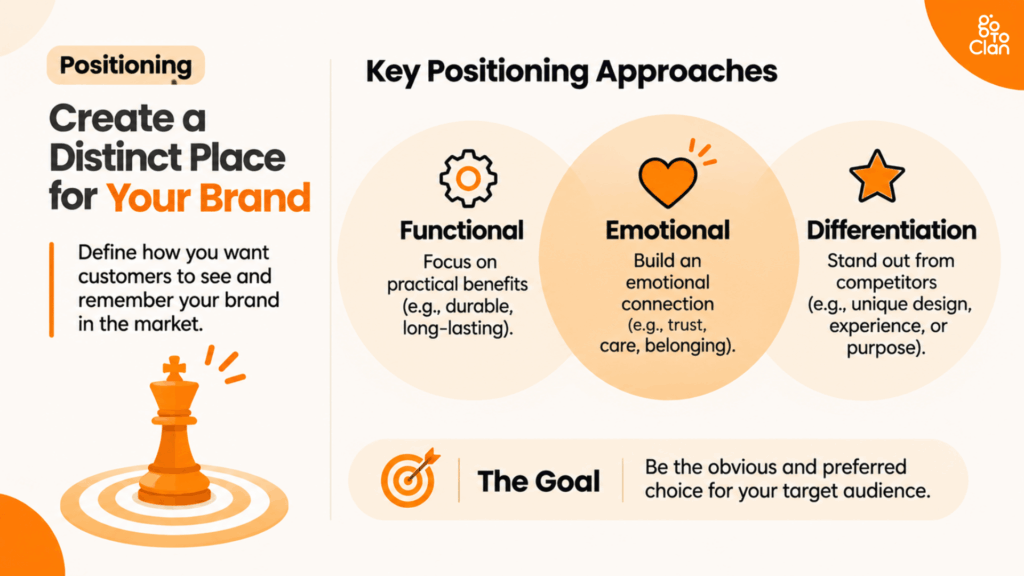
So, you’ve identified your target audience. Great! But why should they buy from you instead of your competitors? That’s where positioning comes in.
Brand positioning is all about creating a distinct image of your brand in customers’ minds. Think about Tata Motors. What’s the first thing that comes to mind? Safety, right? That’s the power of good positioning. In 2027, when customers have hundreds of brands to choose from, having a clear identity matters more than ever.
There are 3 common approaches to brand positioning.
Functional Positioning
Functional positioning focuses on what your product actually does and how well it solves a customer’s problem. It could be better performance, convenience, affordability, durability, or anything that makes life easier.
Take Dyson, for example. Its vacuum cleaners are known for their engineering, suction technology, and cleaning performance. Rather than relying only on attractive designs, Dyson emphasizes what its products can do.
In 2027, brands can use AI tools to study customer reviews, compare product features, and identify common complaints about competing products. These insights can help marketers communicate their product’s strengths more clearly. Of course, the product still needs to deliver what the brand promises!
Symbolic Positioning
Ever wondered why someone would spend thousands of dollars on a luxury handbag when a $100 bag can serve the same purpose? Because people don’t always buy products for their practical benefits.
Symbolic positioning is about what owning a product represents. It could be status, success, exclusivity, personal identity, or belonging to a particular community.
Think about Rolex. Its watches do more than tell time. The brand has built a strong association with prestige, achievement, and luxury.
Even in 2027, when AI-generated advertisements and personalized campaigns are becoming more common, brands can’t manufacture genuine prestige overnight. Reputation, craftsmanship, consistency, and customer experience still play a huge role.
Experiential Positioning
Sometimes, people remember how a brand made them feel more than what they actually purchased. That’s the idea behind experiential positioning.
Think about Starbucks. You can get coffee from hundreds of places, often for much less. But Starbucks has built much of its appeal around the café atmosphere, customization, and the experience of spending time there.
In 2027, brands can use AI-powered customer support, personalized recommendations, and feedback analysis to improve certain parts of the customer experience. As per Cresta’s report, 80% of customer experience leaders reported improvements in customer satisfaction or experience after adopting AI. But technology alone won’t create an emotional connection. Friendly service, thoughtful design, and consistently good experiences still make the biggest difference.
And here’s something worth remembering: A brand doesn’t have to stick to just one positioning approach. Apple, for example, combines functional benefits, premium brand symbolism, and a carefully designed user experience. What matters is choosing a clear positioning strategy that makes sense for your audience.
STP Marketing With Real Brand Examples
Now that we’ve covered the theory, let’s see how brands actually use segmentation, targeting, and positioning. We’ll look at four Indian brands from completely different industries and break down their marketing strategies.
These examples also show something interesting: two brands can sell similar products but target entirely different audiences. And sometimes, a single brand can successfully appeal to multiple customer segments.
1. H.I.M. by Ranveer Singh
Industry: Men’s skincare and grooming
Ranveer Singh and Aman Gupta launched H.I.M. (Handsome Indian Man) in November 2026. In my opinion, their approach to STP marketing is quite interesting. Instead of launching another general skincare brand, they decided to focus specifically on Indian men.
Segmentation: H.I.M. uses demographic and geographic segmentation. The brand focuses on men in India and their grooming needs, particularly concerns related to heat, humidity, pollution, and hard water.
Targeting: The brand appeals to Indian men who want skincare and grooming products designed with their needs in mind. Its initial range includes eight products priced between ₹299 and ₹899, making it accessible to customers beyond the luxury skincare market.
Positioning: H.I.M. positions itself as a science-led grooming brand developed specifically for Indian men. Its messaging emphasizes Indian skin, local environmental conditions, and purpose-built formulations rather than simply selling celebrity-endorsed products.
What’s interesting is how clearly the brand has defined its audience. It isn’t trying to sell skincare to everyone. It’s building its identity around a specific customer group and its everyday grooming concerns.
2. Forest Essentials
Industry: Luxury Ayurvedic beauty and wellness
Ayurvedic skincare has been around for centuries. But Forest Essentials took something deeply traditional and gave it a luxurious identity. From its packaging to its stores and product experience, the brand has made Ayurveda feel premium.
Segmentation: Forest Essentials primarily uses psychographic and income-based segmentation. It appeals to customers who appreciate Ayurvedic traditions, natural ingredients, craftsmanship, and premium beauty experiences.
Targeting: The brand focuses on customers willing to pay more for luxurious skincare and wellness products. Rather than competing with affordable mass-market Ayurvedic brands, it serves consumers who value both traditional ingredients and a premium experience.
Positioning: Forest Essentials has built its identity around “Luxurious Ayurveda.” Its elegant packaging, carefully designed retail spaces, and traditional Indian beauty rituals help create a distinctive premium image.
Here’s the interesting part. Forest Essentials didn’t invent Ayurveda or create an entirely new skincare category. It changed how customers experience and perceive Ayurvedic beauty products. That’s a great example of symbolic and experiential positioning working together.
3. Palmonas
Industry: Jewelry and accessories
Palmonas is an interesting example because it doesn’t limit itself to just one type of jewelry buyer. The brand has made demi-fine jewelry a major part of its identity while also offering options such as real gold and lab-grown diamonds.
Segmentation: Palmonas uses behavioral, psychographic, and income-based segmentation. Some customers want stylish jewelry for everyday wear, some prefer affordable gifting options, and others are interested in precious materials such as gold and diamonds.
Targeting: Its demi-fine collection appeals to a broad audience looking for fashionable jewelry without the price tag of traditional fine jewelry. Meanwhile, its fine jewelry offerings allow it to serve customers interested in higher-value purchases.
Positioning: Palmonas has built much of its identity around making stylish, premium-looking jewelry suitable for everyday life. Its demi-fine pieces sit between inexpensive fashion jewelry and traditional fine jewelry, giving customers another option.
What makes this strategy interesting is that Palmonas can serve different budgets and purchase occasions under one brand. However, its challenge going into 2027 will be maintaining a clear brand identity while expanding across different jewelry categories.
4. Swiggy
Industry: Food delivery and convenience services
Think about how differently people use Swiggy. A college student might order a late-night snack, a working professional might order lunch, and a family might use Instamart for groceries. Same company, completely different customer needs!
Segmentation: Swiggy uses geographic and behavioral segmentation. Customers can be grouped based on location, ordering frequency, food preferences, spending habits, and the services they use.
Targeting: Swiggy serves multiple customer segments through different offerings. Food Delivery caters to people ordering restaurant meals, Instamart serves grocery and household shopping needs, and Dineout helps customers discover restaurants and plan dining experiences.
Positioning: Swiggy has built its broader brand identity around convenience. Whether someone wants dinner delivered, groceries ordered, or a restaurant reservation, the company aims to make these everyday activities easier.
Swiggy also shows how STP in marketing can evolve as a business grows. Instead of serving only one customer need, it has expanded into related services while keeping convenience at the center of its brand.
Key Takeaways
- STP marketing stands for Segmentation, Targeting, and Positioning.
- Segmentation divides customers based on demographics, geography, psychographics, and behavior.
- Targeting helps brands choose customer groups based on size, reachability, profitability, and needs.
- Positioning creates a distinct brand identity through functional, symbolic, or experiential benefits.
- AI in 2027 can help marketers analyze customer behavior, identify patterns, and personalize campaigns.
- Real-world examples like H.I.M., Forest Essentials, Palmonas, and Swiggy show how brands can approach STP differently.
- The biggest lesson: You don’t need to market to everyone. You need to reach the right people with the right message.
Final Words
STP marketing might be an old concept, but it’s definitely not outdated. In fact, with so many brands competing for attention in 2027, understanding your customers has become even more important. AI can help you analyze data, identify patterns, and make better marketing decisions. But it can’t replace a good understanding of your audience or a strong brand strategy.
And remember, you don’t need to target everyone to build a successful business. You just need to understand who your customers are, what they care about, and why they should choose you.
At Go To Clan, we help businesses turn these insights into meaningful branding and marketing strategies. From brand identity and website design to content marketing and AI-powered creative solutions, we help brands communicate with the right audience and stand out in a crowded market.
Frequently Asked Questions
1. Who introduced the STP marketing model?
STP marketing evolved from the concept of market segmentation introduced by Wendell R. Smith in 1956. Philip Kotler later helped popularize segmentation, targeting, and positioning as a structured approach to marketing.
2. What is the difference between STP and the 4 Ps of marketing?
STP helps businesses decide who to market to and how to position their brand. The 4 Ps (Product, Price, Place, and Promotion) focus on how to bring that strategy to life. Ideally, businesses should work on STP before planning their marketing mix.
3. Can small businesses and startups use STP marketing?
Absolutely! In fact, STP can be particularly useful for startups with limited marketing budgets. Instead of competing for everyone’s attention, they can focus on a specific customer group, understand its needs, and create marketing campaigns around those needs.
4. What are the common mistakes businesses make with STP marketing?
One common mistake is targeting too many customer segments at once. Others include relying on outdated customer data, copying competitors’ positioning, ignoring customer feedback, and assuming that all customers within a segment behave the same way.
5. What is the difference between a target market and a buyer persona?
A target market is a broader group of customers a business wants to reach. A buyer persona is a fictional profile representing a typical customer within that group, created using research and customer insights. For example, your target market could be working professionals aged 25-40, while your buyer persona could be a 30-year-old marketing manager who prefers shopping online.