
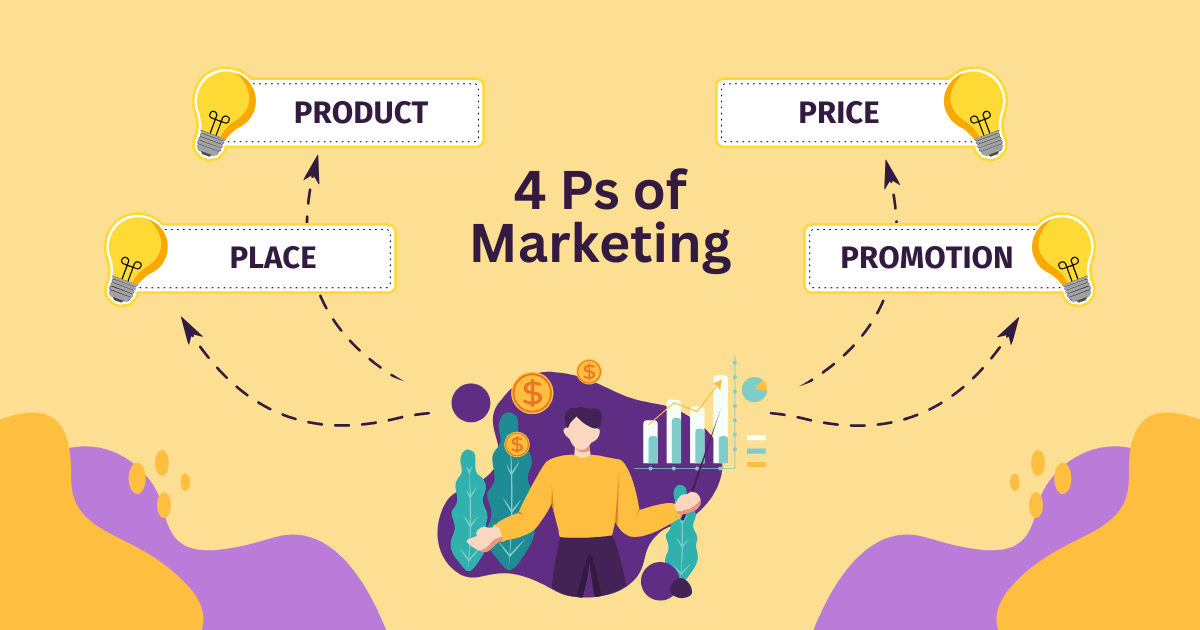
The 4 Ps of Marketing might sound like another complicated marketing theory, but trust me, you have seen them in action countless times. From the ₹10 packet of chips at your neighbourhood grocery store to the latest iPhone, almost every product you come across has a marketing strategy built around these four elements.
Now, think about it. Why does Apple charge a premium for its iPhones? Why can you find Maggi in almost every grocery store in India? And why does McDonald’s keep introducing new offers and combos? There’s a marketing strategy behind each of these decisions.
That’s exactly what we are going to explore in this blog. We will understand the four Ps, look at some interesting examples from popular brands, and see how you can use this concept for your own business.
Key Takeaways
- The 4 Ps of Marketing are Product, Price, Place, and Promotion.
- Product focuses on what you sell and how it meets customer needs.
- Price determines what customers pay and how your brand is positioned.
- Place ensures your products are available where customers prefer to shop.
- Promotion helps customers discover, remember, and buy your products.
- All four Ps must work together for an effective marketing strategy.
- The 7 Ps extend the concept by adding People, Process, and Physical Evidence.
- The concept remains relevant for traditional businesses, e-commerce, and digital marketing.
What Are the 4 Ps of Marketing?
The 4 Ps of Marketing, also known as the Marketing Mix, are four important elements that businesses consider while marketing their products or services. These are Product, Price, Place, and Promotion.
The concept of the Marketing Mix was introduced by Neil Borden in the 1950s. Later, in 1960, marketing professor E. Jerome McCarthy simplified it into the four Ps that we know today.
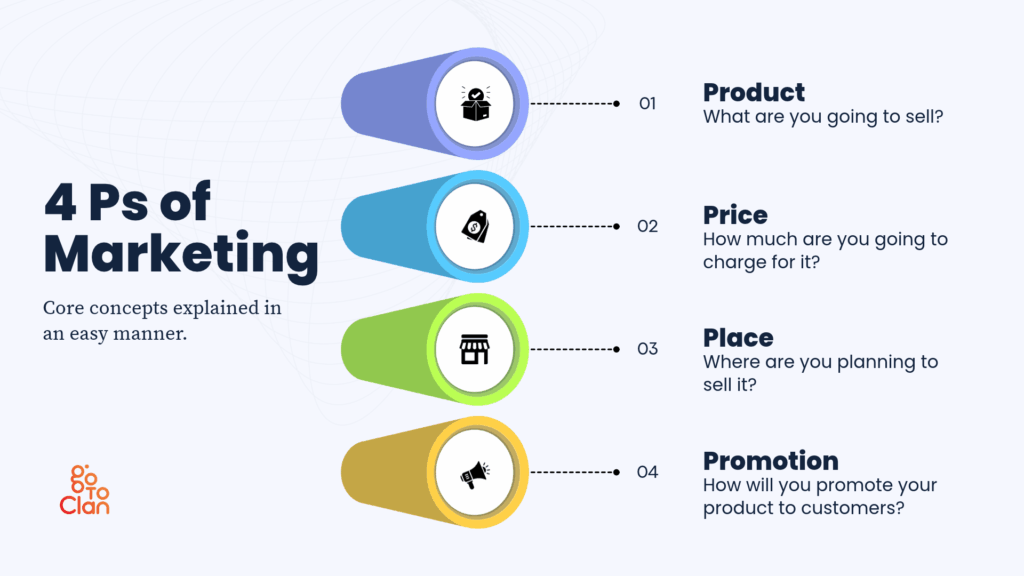
Here’s what each P means:
- Product: What are you selling, and why would someone want to buy it?
- Price: How much are customers willing to pay for your product?
- Place: Where and how can customers purchase your product?
- Promotion: How will you tell people about your product and convince them to buy it?
The interesting thing is that these four elements don’t work independently. For example, you cannot market a luxury watch the same way you market an affordable everyday watch. The product, pricing, distribution, and advertising need to complement each other.
That’s the whole idea behind the 4 Ps of Marketing. Making sure all four elements work together to attract the right customers and achieve your business goals.
1. Product: What Are You Selling?
The first P in the 4 Ps of Marketing stands for Product. It refers to what a business offers its customers. It could be a physical product like a smartphone or a pair of shoes, or a service like website development, insurance, or food delivery.
But here’s something important. Customers don’t always buy a product just because it exists. They buy it because it solves a problem, fulfils a need, or makes their lives better in some way.
For example, when you buy a water bottle, you might look at its capacity, material, design, and durability. But when you buy a premium bottle from Stanley, you might also be paying for its brand image, appearance, and popularity.
So, while developing a product strategy, businesses need to think about more than just the product itself. Its quality, features, packaging, branding, design, and after-sales service can all influence a customer’s buying decision.
Questions to ask while planning your product strategy:
- What problem does my product solve?
- Who is most likely to buy it?
- How is it different from competing products?
- What features or benefits matter most to customers?
- What can I improve to make the product more appealing?
Remember, even the most creative advertising campaign cannot consistently compensate for a product that fails to meet customer expectations.
2. Price: How Much Should Customers Pay?
The second P in the 4 Ps of Marketing is Price. It refers to the amount customers pay to purchase a product or service. But pricing isn’t just about calculating production costs and adding a profit margin. It also depends on your target audience, competitors, brand positioning, and the value customers see in your product.
Think about a cup of coffee. You might pay ₹20 for coffee at a roadside stall and ₹250 for one at Starbucks. Both serve coffee, but the experience, ambience, convenience, and brand image are different. That’s why customers are willing to pay different prices.

But just because a product is expensive doesn’t mean it’s overpriced. Sometimes, there’s a lot more behind that price tag than meets the eye. Take this beautiful Vistaar Skirt by Reshakaar by Rosh, for example. Priced at ₹15,800, it is crafted from 100% linen and features twenty alternating panels in Dusty Rose and Rice White. Each white panel has intricate, hand-embroidered Kantha work, which adds beautiful texture and detailing to the skirt.
Just imagine the amount of time, skill, and effort that goes into creating those delicate patterns by hand! The choice of fabric, thoughtful design, craftsmanship, and attention to detail all contribute to the product’s value. Naturally, you cannot compare the pricing of such a thoughtfully crafted garment with a mass-manufactured skirt. This is why pricing isn’t always about being affordable. It’s also about helping customers understand what makes your product worth its price.
Businesses use different pricing strategies depending on their goals. Some keep prices low to attract more customers, while others charge premium prices to position their products as exclusive or luxurious.
Some common pricing strategies include:
- Penetration Pricing: Introducing a product at a low price to attract customers and gain market share.
- Premium Pricing: Charging higher prices to reflect exclusivity, quality, or brand value.
- Competitive Pricing: Setting prices based on what competitors charge for similar products.
- Psychological Pricing: Pricing a product at ₹999 instead of ₹1,000 to make it appear more affordable.
- Bundle Pricing: Selling multiple products together at a combined price, like a burger, fries, and cold drink combo.
Questions to ask while planning your pricing strategy:
- How much are my customers willing to pay?
- What are my competitors charging?
- Does my pricing match my brand positioning?
- Will the selling price cover my costs and generate sufficient profit?
- Should I offer discounts, subscriptions, or product bundles?
Remember, the cheapest product doesn’t always win. Customers often pay more when they believe they’re getting better quality, convenience, or overall value.
3. Place: Where Can Customers Buy Your Product?
The third P in the 4 Ps of Marketing is Place. In simple words, it is about making your product available to customers. After all, what’s the point of having a good product if people have to struggle to find it?
Take Maggi, for example. Whether you visit a supermarket in Mumbai or a small grocery shop in a village, there’s a good chance you’ll find Maggi on the shelves. Nestlé has built a huge distribution network to make sure its products reach customers across India.
But not every brand wants to be available everywhere. Take Rolex. You cannot simply walk into any watch shop and buy a Rolex. The brand sells through selected authorised retailers. This helps Rolex maintain control over how its watches are sold and presented to customers.
So, depending on the product and target audience, businesses choose different ways to sell their products.

Here are some common distribution strategies:
- Direct Distribution: Selling products directly to customers through your own store or eCommerce website.
- Indirect Distribution: Selling through distributors, wholesalers, or retailers.
- Intensive Distribution: Making products available in as many suitable stores as possible. Think of biscuits, chocolates, or soft drinks.
- Selective Distribution: Choosing a limited number of retailers to sell your products.
- Exclusive Distribution: Giving a particular retailer exclusive selling rights in a specific area.
And of course, Place isn’t just about physical shops anymore. Today, businesses can sell through their websites, Amazon, Flipkart, Instagram, and several other online platforms. Wanna know how much it costs to build an eCommerce Website? Learn here https://gotoclan.com/typical-cost-to-build-an-ecommerce-site/
Questions to ask while planning your distribution strategy:
- Where do my customers usually shop?
- Should I sell online, offline, or both?
- Do I need retailers or distributors?
- How much will storage, shipping, and delivery cost?
- How can I make it easier for customers to buy my product?
The important thing is to understand your customers’ shopping habits. If your audience prefers buying online, having a beautiful physical store alone might not be enough. Similarly, if you’re selling everyday grocery products, depending only on your website may not be the best idea.
4. Promotion: How Will People Know About Your Product?
The fourth P in the 4 Ps of Marketing is Promotion. You’ve developed a good product, decided its price, and made it available in the right places. But how will people know that your product exists? That’s where promotion comes in.
Remember Vodafone’s ZooZoo advertisements? Those funny little white characters became so popular that people actually looked forward to watching the ads. Or think about Cadbury’s Kuch Meetha Ho Jaaye campaign. Instead of simply telling people to buy chocolate, Cadbury connected its products with India’s tradition of celebrating happy moments with something sweet.
That’s what promotion is all about. It’s not just about running advertisements or announcing discounts. It’s about giving people a reason to notice your brand, remember it, and eventually buy from you.
Here are some common promotional methods:
- Advertising: Running ads on television, Google, social media, newspapers, billboards, and other platforms.
- Sales Promotion: Offering discounts, cashback, coupons, free samples, or limited-time deals.
- Public Relations (PR): Building a positive brand image through media coverage, events, and public communication.
- Content Marketing: Creating blogs, videos, social media posts, and other useful content to attract and educate potential customers.
- Influencer Marketing: Collaborating with content creators who can introduce your products to their audiences.
- Direct Marketing: Reaching customers through emails, SMS, WhatsApp, or other direct communication channels.
But here’s the catch. Just because Instagram is popular doesn’t mean every business should spend its entire marketing budget on Instagram ads. A B2B software company might get better results through LinkedIn, SEO, or industry events, while a fashion brand might benefit more from Instagram and influencer collaborations.
Questions to ask while planning your promotional strategy:
- Who am I trying to reach?
- Which platforms does my target audience use?
- What should people remember about my brand?
- How much can I afford to spend on promotion?
- How will I measure whether my marketing efforts are working?
One thing worth remembering is that promotion doesn’t always mean spending lakhs on advertising. Sometimes, a creative campaign, an interesting social media post, or a genuinely useful blog can bring your brand to the attention of thousands of potential customers.
4 Ps of Marketing With Real-Life Examples
Now that we have understood all four Ps individually, let’s see how they work together. And what better way to understand this than by looking at brands we already know?
1. Apple
Apple is a great example of how a brand can use the 4 Ps of Marketing to build a premium image.
- Product: iPhones, MacBooks, iPads, Apple Watches, and other products known for their design, user experience, and integration with Apple’s ecosystem.
- Price: Apple generally follows a premium pricing strategy. Its products are often priced higher than many competing alternatives.
- Place: Apple sells through its official website, Apple Stores, authorised resellers, and selected online retailers.
- Promotion: Apple focuses heavily on product features, design, innovation, and user experience. Think about its product launch events and the excitement around every new iPhone.
2. Amul
Amul is an interesting example because its marketing approach is quite different from Apple’s. While Apple focuses on premium positioning, Amul caters to a much broader audience.
- Product: Milk, butter, cheese, ice cream, curd, chocolates, and several other dairy products.
- Price: Amul offers products across different price points, making many of its everyday dairy products accessible to a large customer base.
- Place: Its products are sold through grocery stores, supermarkets, Amul outlets, and online grocery platforms across India.
- Promotion: Who doesn’t remember the Amul girl? Amul’s topical advertisements have been commenting on current events, politics, sports, and popular culture for decades.
3. McDonald’s
McDonald’s is another familiar example. Its marketing strategy is built around convenience, recognisable products, and adapting to local tastes.
- Product: Burgers, fries, beverages, desserts, and meal combos. In India, McDonald’s has introduced vegetarian options like McAloo Tikki to suit local food preferences.
- Price: The brand offers products at different price points, including value meals and combos, to appeal to different customer groups.
- Place: McDonald’s sells through restaurants, takeaway counters, drive-throughs at selected locations, and online food delivery platforms.
- Promotion: McDonald’s uses television and digital advertising, limited-time offers, meal deals, and campaigns featuring its popular menu items.
4. boAt
boAt is an Indian electronics brand that has made a name for itself in the audio accessories market. What’s interesting about boAt is how it has managed to make headphones, earphones, and speakers fashionable, especially among younger audiences.
- Product: Wireless earbuds, headphones, Bluetooth speakers, soundbars, smartwatches, and other electronic accessories. boAt pays attention to trendy designs, colours, and features that appeal to young consumers.
- Price: The brand largely follows an affordable pricing strategy, offering stylish audio products at prices that are accessible to students and young professionals.
- Place: boAt sells through its official website, Amazon, Flipkart, other online marketplaces, and offline electronics retailers.
- Promotion: boAt has collaborated with celebrities, cricketers, and influencers to build its brand image. Its association with personalities like Hardik Pandya and Kiara Advani, along with its youth-focused campaigns, has helped position boAt as a lifestyle brand rather than just another electronics company.
What Can We Learn From These Examples?
Notice something interesting? All four brands follow the same four marketing principles, but their strategies are completely different.
Apple doesn’t need to compete with every smartphone brand on price. Amul doesn’t need exclusive luxury stores to sell butter. McDonald’s doesn’t need to offer the same menu in every country. And boAt has shown how affordable electronics can also be marketed as fashionable lifestyle accessories.
That’s because the 4 Ps of Marketing aren’t a fixed formula. Businesses need to adjust each element according to their products, customers, competition, and overall goals.
How to Create a 4 Ps Marketing Strategy for Your Business
Okay, so we have seen how Apple, Amul, McDonald’s, and boAt use the 4 Ps of Marketing. But what if you’re running a small business or planning to launch your own product? How do you actually put this concept into practice?
Let’s understand this with a simple example. Imagine you’re starting a homemade chocolate brand.
Step 1: Decide What You’re Going to Sell (Product)
First, figure out what makes your chocolates worth buying. Are they handmade? Do you offer unique flavours? Are you planning to sell assorted chocolate gift boxes?
Let’s say you decide to make handmade chocolates with interesting flavours and attractive gift packaging. Your target customers are people looking for birthday gifts, festive hampers, and corporate gifts.
Step 2: Work Out Your Pricing (Price)
Now comes the money part. Calculate how much you spend on ingredients, packaging, labour, and delivery. Check what other handmade chocolate brands are charging.
For example, you might price a box of six chocolates at ₹299 and a premium gift hamper at ₹999. These are hypothetical prices, of course. Your actual prices should depend on your costs, profit margins, and what customers are willing to pay.
Step 3: Decide Where to Sell (Place)
You don’t necessarily need to rent a shop to start selling chocolates.
You could begin by taking orders through Instagram and WhatsApp, creating a simple e-commerce website, or participating in local exhibitions and flea markets. You could also approach nearby gift shops and cafés to stock your chocolates.
The idea is to start with channels that are convenient for your customers and manageable for your business.
Step 4: Tell People About Your Brand (Promotion)
Now that your chocolates are ready, how will you get people to try them?
You could post videos of your chocolate-making process on Instagram, share customer reviews, collaborate with local food bloggers, or introduce special gift hampers for Diwali and Valentine’s Day.
You could also run small, location-targeted Instagram ads to reach people looking for gifting options in your city.
Step 5: See What’s Working and Make Changes
Your marketing strategy doesn’t have to be perfect from day one.
Maybe your ₹299 chocolate boxes sell really well, but the ₹999 hampers don’t get many orders. Or perhaps Instagram brings plenty of inquiries, but most actual purchases happen through WhatsApp.
Pay attention to these patterns. Talk to customers, track your sales, and make changes wherever necessary.
And that’s how you can start applying the 4 Ps of Marketing to a real business. You don’t need a huge marketing budget. You just need to understand what you’re selling, who you’re selling it to, where they can buy it, and how you’ll convince them to give it a try.
4 Ps vs. 7 Ps of Marketing: What’s the Difference?
So far, we’ve discussed Product, Price, Place, and Promotion. But if you’ve studied marketing before, you might have also come across something called the 7 Ps of Marketing.
The concept is pretty simple. The original four Ps were primarily developed around marketing products. But when it comes to services like banking, hospitality, healthcare, or digital marketing, there are a few more things businesses need to consider.
That’s where the additional three Ps come in: People, Process, and Physical Evidence.
People refers to everyone involved in delivering a product or service and interacting with customers. Process is about how the service is delivered, from the first inquiry to the final experience. And Physical Evidence refers to the tangible things that help customers judge the quality and credibility of a business.
Let’s take a hotel as an example.
The rooms and services it offers are its Product. Room rates are its Price. Its location and booking platforms come under Place, while advertisements and travel website promotions fall under Promotion.
But there’s more to running a successful hotel, right?
The behaviour of the reception staff and housekeeping team comes under People. The experience of booking a room, checking in, and checking out is part of the Process. And things like room cleanliness, interior design, signage, and the overall appearance of the property contribute to Physical Evidence.
So, Should You Use 4 Ps or 7 Ps?
Both models are useful. The 4 Ps of Marketing are a good starting point for understanding the basic marketing decisions of almost any business.
The 7 Ps take things a little further, especially for service-based businesses where customer interactions, service delivery, and the overall experience play an important role.
And remember, you don’t necessarily have to choose one over the other. The additional three Ps simply help you examine aspects of your business that the original model doesn’t explicitly cover.
Are the 4 Ps Still Relevant in Digital Marketing?
Absolutely! The 4 Ps of Marketing were introduced long before Google, Instagram, Amazon, or even the internet existed. But that doesn’t mean the concept is outdated. What has changed is how businesses apply these four elements.
Take Product, for example. Earlier, businesses largely depended on market research, surveys, and customer feedback collected through traditional channels. Today, they can also study online reviews, website behaviour, and customer feedback on social media to understand what people want.
Price has changed quite a bit, too. Customers can compare prices across multiple websites within seconds. Businesses can experiment with subscription plans, online-exclusive discounts, and different pricing models. Think about how Netflix offers different subscription plans depending on the features and viewing experience customers want.
When it comes to Place, the internet has opened up several possibilities. A small business in Pune can sell products to customers across India through its website or online marketplaces. Even service-based businesses can work with clients from different countries without having a physical office there.
And then there’s Promotion, which has probably seen the most noticeable transformation. Instead of depending only on newspapers, television, and billboards, businesses can now reach specific audiences through Google Ads, social media, SEO, email marketing, and influencer collaborations. They can also track how many people clicked an advertisement, visited their website, or made a purchase.
What’s interesting is that digital marketing hasn’t replaced the 4 Ps of Marketing. It has simply given businesses more ways to work with them.
So, whether you’re launching an online clothing store, promoting a mobile app, or running a local restaurant, the four basic questions remain the same: What are you selling? How much will it cost? Where can people buy it? And how will they hear about it?
Final Thoughts on the 4 Ps of Marketing
The 4 Ps of Marketing have been around for decades, and there’s a good reason why they’re still taught in business schools. They help businesses look at marketing beyond advertisements and sales. Because marketing isn’t just about getting people to notice your product, it’s also about offering something they want, pricing it sensibly, and making it easy for them to buy.
And you don’t have to be Apple, Amul, or McDonald’s to apply these principles. Even a small business can use them to make better marketing decisions.
At Go To Clan, we help businesses bring their marketing ideas to life through branding, content creation, website development, SEO, and digital marketing. Whether you’re launching a new brand or trying to grow an existing one, we’d love to help you figure out how to market it better.
Have a business idea or a brand that needs a fresh marketing approach? Contact Go To Clan.
Frequently Asked Questions About the 4 Ps of Marketing
1. What is the most important P in the 4 Ps of Marketing?
There is no single most important P. All four elements are connected. However, many businesses start with Product because they first need to understand what they’re selling and who needs it. Even a great promotional campaign may struggle if the product doesn’t meet customer expectations.
2. What is the difference between the 4 Ps and 4 Cs of Marketing?
The 4 Ps focus on marketing from a business’s perspective, while the 4 Cs look at it from the customer’s perspective. The 4 Cs are Customer Value, Cost, Convenience, and Communication. For example, instead of simply deciding a product’s price, the 4 Cs encourage businesses to consider the total cost a customer bears, including delivery charges, time, and effort.
3. What are some common mistakes businesses make while applying the 4 Ps of Marketing?
One common mistake is focusing too much on promotion while ignoring the other three elements. For example, a business might spend heavily on Instagram advertisements without checking whether its products are competitively priced or easily available. Another mistake is copying a competitor’s marketing strategy without understanding whether it suits their own customers.
4. How often should a business review its marketing mix?
There’s no fixed rule. However, businesses should review their marketing mix whenever customer preferences, competition, market conditions, or business goals change. For example, if a competitor launches a similar product at a lower price, you may need to reconsider your pricing or communicate your product’s additional value more effectively.
5. Can the 4 Ps of Marketing be applied to personal branding?
Yes! Let’s say you’re a freelance graphic designer. Your design services become the Product, your project fees are the Price, platforms like LinkedIn, Behance, and your portfolio website represent Place, and your social media content, networking, and referrals contribute to Promotion. The same principles can help freelancers and professionals market their skills.