
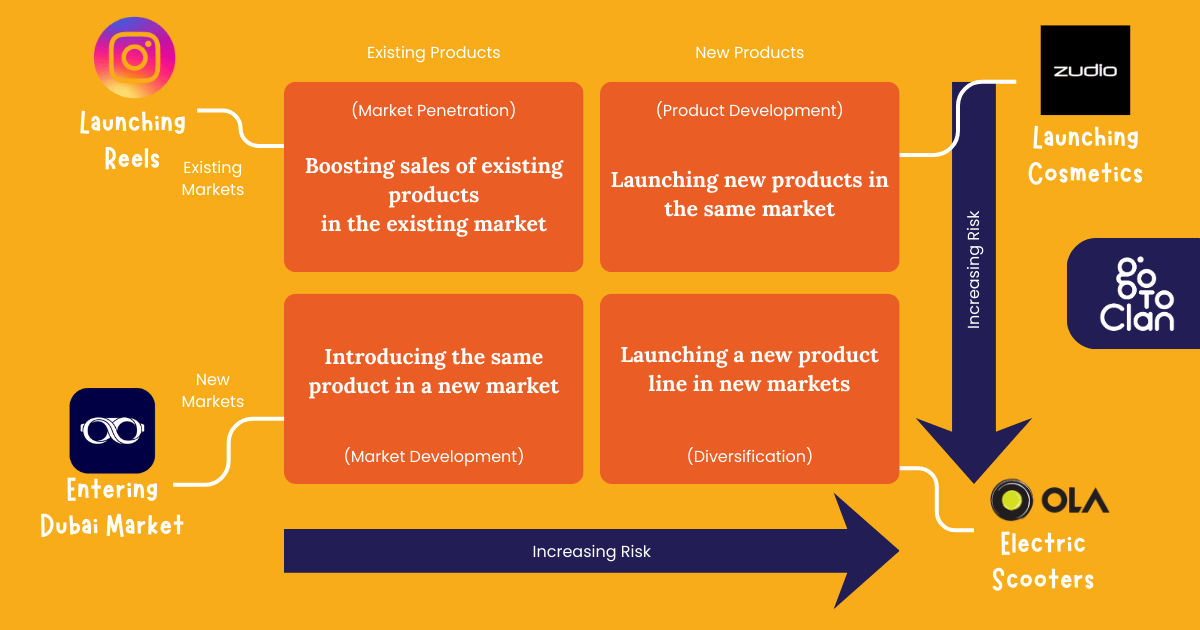
Business people will relate to this. Once your business is all set, you do not stop. You start thinking about growth. How can I grow my business? What can I do to expand my product line or market? Ansoff Matrix answers these questions.
Ansoff Matrix is a super-simple tool that shows four clear ways a business can grow. No jargon. No MBA-level drama. Just a clean framework that helps you understand how companies expand their products and markets.
Let’s break it down in the simplest way possible.
What is the Ansoff Matrix
Before understanding the Ansoff Matrix, you need to know why it even exists. Every business eventually reaches a point where regular marketing, discounting, and branding are not enough to grow. The company needs a direction. A clean framework. A way to answer: “What should we do next to grow?” That is where the Ansoff Growth Matrix helps. It gives you four strategic paths based on only two things: your product and your market.
The model removes confusion because it simplifies growth decisions. Instead of running behind random ideas, it forces you to think logically. Should you sell more of the same product? Should you enter a new market? Should you build something new? Or should you take a bold jump and try something completely different? The Ansoff Matrix keeps the thought process structured.
Now let’s break down the four quadrants of the Ansoff Matrix in detail.
Ansoff Growth Matrix
1. Market Penetration
Market Penetration means selling more of your existing product to the same market. You are not changing anything major. You are only trying to increase your share in the current space. It’s a basic sales upgrade, like how we introduce new schemes to boost sales.
This usually happens through discounts, heavy marketing, referral programs, loyalty perks, and improving distribution. The idea is simple. If customers already know you, give them a reason to buy more or buy more often.
This strategy is the safest of all four because nothing new is introduced. You already know your audience, your product, and the demand patterns. So the risk is low, and the growth comes from a deeper reach.
Ansoff Matrix Example:
McDonald’s India increased footfall by introducing ₹59 – ₹99 value menus, which brought in a massive surge of repeat customers. This is Market Penetration: sell more to the same audience through pricing tactics.
If you run a tech product or platform, you can introduce new and unique features to gain more customers. When Instagram launched Reels, its average user time increased for many markets. Source. This is an Ansoff growth matrix penetration strategy designed to deepen engagement within the same user base.
2. Market Development
Market Development means taking your existing product into a completely new market. The product stays the same. The people change.
This could mean entering new cities, targeting a new demographic, or even going international. Companies choose this when they feel they have saturated their current market or see untapped potential somewhere else.
This strategy has moderate risk because the product is tested, but the new market is not. You don’t know customer behavior there. You don’t know competition dynamics. So research matters a lot here.
There is a reason why luxe brands like LV do great business in major cities like Mumbai and Bengaluru. You won’t see their showrooms in tier 2 and tier 3 cities. Does that mean the brand and its products are not good? No. It means that some brands target a niche audience.
Ansoff Matrix Example:
Nykaa is expanding from metro cities to Tier 2 and Tier 3 cities using faster delivery and regional influencers.
Lenskart took its existing eyewear portfolio and expanded into Dubai and other Gulf countries. Same product. New audience. Source.
This move helped them access a premium segment where customers willingly pay higher prices for stylish prescription glasses.
3. Product Development
Product Development means creating new products for your existing customers. Here, the audience does not change. Only what you offer changes.
Brands use this when they want customers to stick with them longer. If you know your users well and understand what gaps they still have, you can build products that make them spend more within your ecosystem.
This strategy has a higher risk because building something new always needs investment, testing, and iteration. But if executed well, it deepens customer loyalty and increases lifetime value.
Ansoff Matrix Example:
Zomato launching Zomato Gold and Zomato Pay for its existing users to make them order more frequently.
Zudio’s core buyers come for affordable fashion. Seeing the same demand patterns, they added cosmetics, perfumes, and skincare under ₹199–₹299. New product range. Same massive customer base.
4. Diversification
Diversification means launching a new product in a new market. This is the boldest quadrant in the Ansoff Growth Matrix because everything is new. New customers and a completely new offering.
Brands use this strategy when they want to reduce dependence on a single industry or want to enter a fast-growing category. It requires courage, research, and a long-term view.
Risk is the highest here. But the reward is also massive because you open up entirely fresh revenue streams.
Ansoff Matrix Example:
Amazon moving from e-commerce into cloud computing with AWS, which later became its biggest revenue engine.
Ola was a ride-hailing platform. Then it took a bold leap into manufacturing electric scooters in a completely different market. New product. New customer base. High-risk diversification that paid off.
TATA is another excellent example of Diversification. From salt to cars, they are into almost everything: Titan watches, Tanishq jewellery, TATA Sky, TATA grocery, and much more.
Ansoff Matrix Template
A clean Ansoff Matrix template must do more than show four boxes. It should help you think like a strategist. Here is a more structured version that brands actually use:
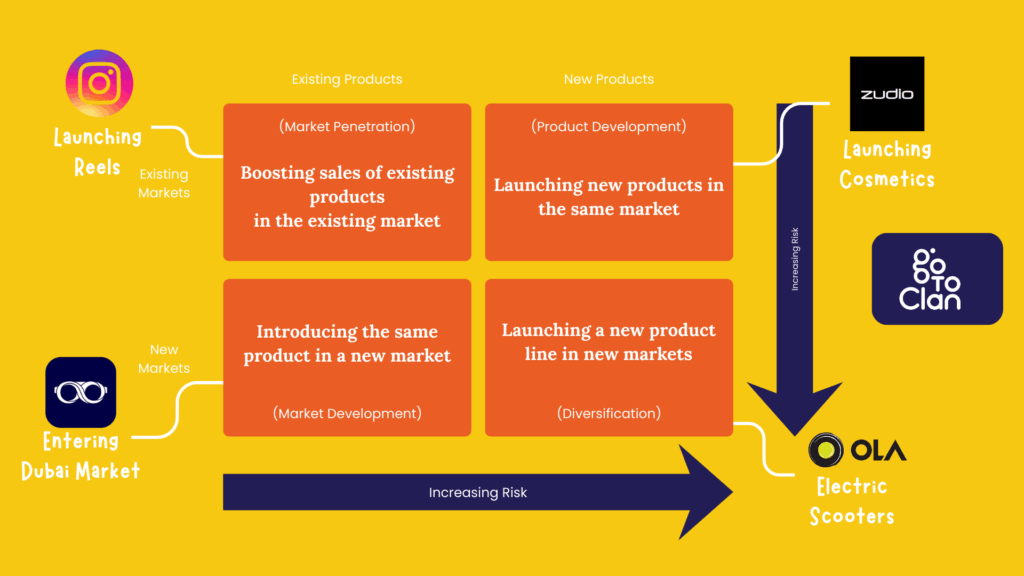
1. The Basic Grid
2. What Each Box Should Include
You can use this Ansoff Matrix template to plan growth by asking key questions for every quadrant.
Market Penetration Template Inputs
Target: current customers
Goal: increase usage, frequency, or share
Tactics: ads, price cuts, offers, improved distribution
Risk level: low
Market Development Template Inputs
Target: new locations or new customer groups
Goal: expand reach
Tactics: new region launch, language tweaks, new channels
Risk level: medium
Product Development Template Inputs
Target: existing customers
Goal: introduce new products
Tactics: R&D, feedback loops, bundling
Risk level: medium to high
Diversification Template Inputs
Target: new markets + new products
Goal: explore new industries
Tactics: innovation, partnerships, acquisitions
Risk level: highest
3. How to Use This Ansoff Matrix Template in Real Life
When you fill this template, the idea is not to pick all four quadrants. You pick one or two based on budget, risk appetite, competition pressure, and long-term vision. The Ansoff Matrix simply clarifies the path and removes confusion.
If you want, I can also create a downloadable PDF template or turn this into a Canva-ready layout with color-coded quadrants.
Conclusion
The Ansoff Matrix gives brands a simple way to think about growth without overcomplicating things. Whether you want to sell more of what you already have, enter a new market, build fresh products, or take a bold leap into a new space, this framework keeps your decisions clear and logical. It shows you where the risk lies, what opportunities you can unlock, and how each move can shape the future of your business.
At Go To Clan, we use the same structured thinking when we help brands grow. From positioning and product strategy to marketing campaigns and content, we don’t guess our way through decisions. We analyse, plan, and choose the right quadrant for your brand’s stage. Because strong creativity matters, but the right direction matters even more.